Showing Posts From
Localization
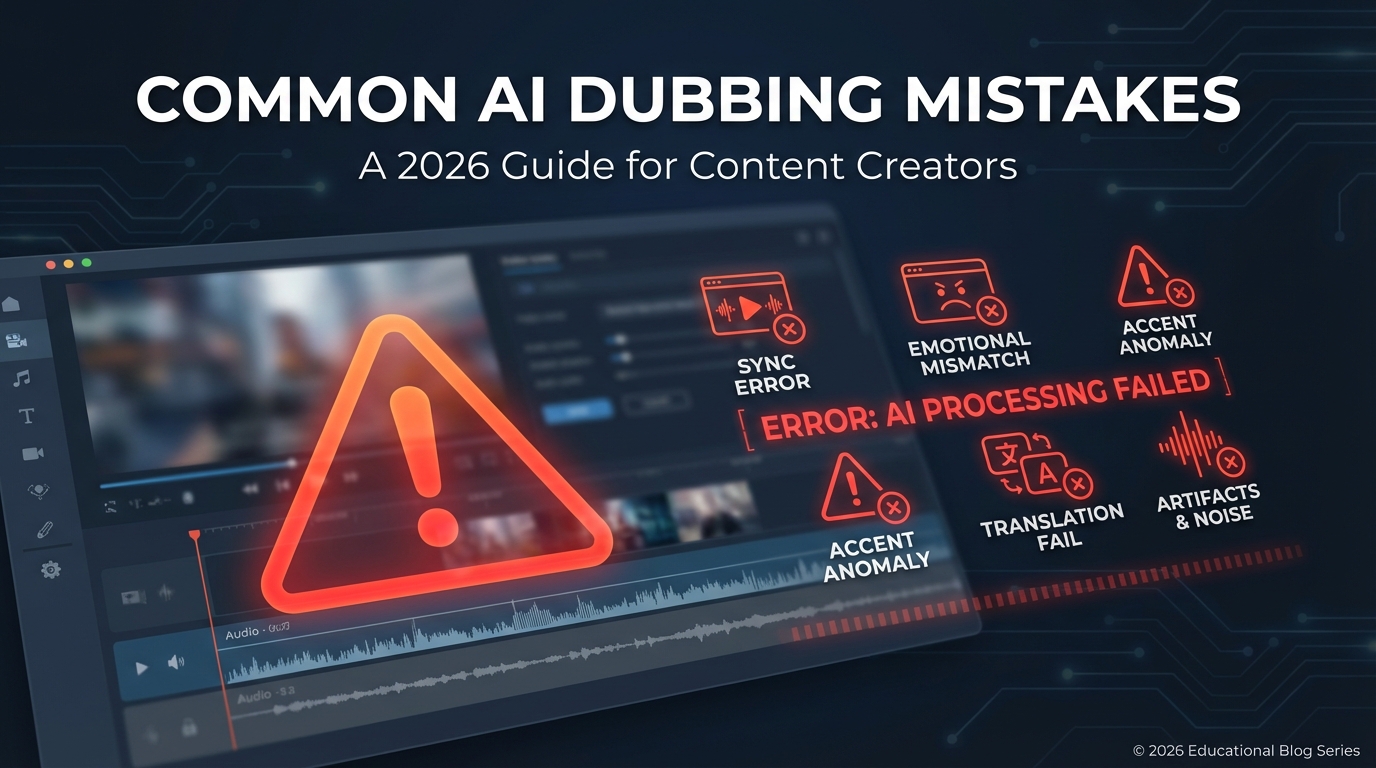

10 Fatal AI Dubbing Mistakes (and How to Avoid Them)
Over the past two years, I've dubbed hundreds of videos with AI and made practically every mistake possible. Some cost me hours of extra work, others compromised the quality of important projects. The good news? Now I know exactly what NOT to do. This guide collects the 10 most common mistakes I see repeated constantly - both in my early projects and in those of other creators who ask for my help. If you're starting with AI dubbing, this article will save you time, money, and frustration. ❌ Mistake 1: Poor Original Audio Quality The problem: AI can't work miracles. If your original audio has background noise, echo, or inconsistent volume, the dubbed result will amplify these defects. Why it happens: Many think AI "cleans up" audio automatically. In reality, AI analyzes and replicates what it finds - defects included. The solution:Always record in a quiet environment Use a decent microphone (even a €50 USB one makes a difference) Apply noise reduction BEFORE uploading the video Verify that volume is consistentPro Tip: Audacity is free and has an excellent noise reduction filter. 5 minutes of audio post-production before dubbing can transform the final result.❌ Mistake 2: Translating Titles with Google Translate The problem: You dubbed a video perfectly, but the literally translated title doesn't work in the target market. Nobody finds the video, nobody clicks. Why it happens: It seems logical to translate the title along with the content. But the keywords that work in English aren't necessarily what people search for in Spanish or Portuguese. The solution:Do keyword research in the target language (see our SEO article) Don't translate - recreate the title optimized for that market Use native expressions, not literal translationsPractical example:❌ "How to make authentic carbonara pasta" → "Cómo hacer pasta carbonara auténtica" (literal translation) ✅ "How to make authentic carbonara pasta" → "Receta Carbonara Original - El Secreto del Chef Italiano" (optimized for Spanish keywords)❌ Mistake 3: Ignoring Cultural Differences The problem: The content works great in your market but falls flat in others. References, humor, examples don't translate. Why it happens: We focus on linguistic translation forgetting that culture matters as much as language. The solution:Identify culture-specific references before dubbing Consider whether to replace them with local equivalents For very culturally-specific content, consider different versions instead of translationsCommon problem examples:References to local TV shows Jokes based on wordplay Idiomatic expressions without equivalents References to national events or personalitiesWarning: Some content simply doesn't translate. A video entirely based on an American meme might not make sense to a Brazilian audience. Better to recognize this and not dub it.❌ Mistake 4: Not Verifying Results The problem: You upload, dub, publish without ever watching the result. Then you discover that the AI mistranslated a key term or there's a sync problem. Why it happens: Excessive trust in AI or rush to publish. The solution:ALWAYS watch at least the first 2-3 minutes of the dubbed video Check passages with numbers, proper names, or technical terms Have a native speaker verify if possible For critical content (courses, corporate videos), complete review is mandatoryQuick verification checklist: Audio synced with lips? Numbers pronounced correctly? Proper names handled well? Technical terms translated correctly? Volume consistent?❌ Mistake 5: Forgetting Subtitles The problem: You dubbed the video but didn't add subtitles in the new language. You lose SEO, accessibility, and those who prefer watching on mute. Why it happens: Dubbing seems sufficient. Subtitles seem redundant. The solution:Always add CC (closed captions) in the dubbing language YouTube uses subtitles for SEO - they're essential NovaDub automatically generates subtitles along with dubbingImportant: According to YouTube, videos with subtitles have on average 15% more watch time. Many people watch on mute or in noisy environments.❌ Mistake 6: Dubbing Videos with Too Many Speakers The problem: Your video has 5 people talking, often simultaneously. The AI produces a confused and unnatural result. Why it happens: AI works best with single speakers or well-defined turn-taking. More people = more difficulty. The solution:Ideally, dub videos with 1-2 speakers If there are more people, ensure they never speak simultaneously For interviews/podcasts with many guests, evaluate if dubbing is the right choiceWhen NOT to use AI dubbing:Chaotic group discussions Videos with lots of overlapping speech Content where each speaker's vocal identity is crucial❌ Mistake 7: Expecting Miracles with Music Videos The problem: You upload a video with loud music and quiet voice hoping the AI will magically separate everything. Why it happens: AI can separate voice and music, but it's not infallible. If the original mix is unbalanced, the result will be compromised. The solution:During production, keep voice at least 6-10 dB above music If possible, export a version with lower music for dubbing For actual music videos (sung), AI dubbing isn't the right tool❌ Mistake 8: Publishing Everything Simultaneously The problem: You dub 20 videos and publish them all on the same day. YouTube doesn't know which to prioritize, the audience is overwhelmed. Why it happens: The excitement of finally having content in multiple languages. The solution:Distribute content over time For new channels in new languages, 1-2 videos per day maximum Let each video have time to perform before publishing the next Plan a sustainable content strategyPro Tip: Start with your 5-10 best videos. See how they perform, collect feedback, optimize the process. Then scale.❌ Mistake 9: Using the Same Thumbnail for All Markets The problem: Your thumbnail with Italian text is used for the Spanish version too. Or worse, the thumbnail shows something that doesn't work in that market. Why it happens: It seems like a minor detail compared to the dubbing itself. The solution:If the thumbnail contains text, translate it Verify that visual elements work in the target market Consider A/B testing different thumbnails per market Keep branding consistent but adapt the details❌ Mistake 10: Not Measuring Results The problem: You dub videos without ever analyzing which work and which don't. You keep making the same mistakes. Why it happens: Lack of time, lack of system, or simply not knowing what to look at. The solution:Set up tracking for each language/market separately Monitor CTR, retention, and conversions by market Identify patterns: which content works where? Iterate based on data, not assumptionsMetrics to compare between markets:CTR (if it varies a lot, title/thumbnail problem) Average retention (if it drops vs. original, dubbing quality problem) Engagement rate (if low, cultural resonance problem)Note: Create a simple spreadsheet to track each video's performance in each language. After a few months, you'll have valuable data to optimize your strategy.✅ The Anti-Mistake Checklist Before publishing each dubbed video, verify: Pre-Dubbing: Original audio clean and clear Single speaker or defined turns Culturally adaptable contentPost-Dubbing: Audio quality verified Sync checked Technical terms correct Subtitles generatedPre-Publishing: Title optimized (not just translated) Description localized Appropriate tags Thumbnail adapted Strategic scheduling🎯 Conclusion Most AI dubbing mistakes aren't technical AI errors, but human errors in the process. The AI does its job - it's us who must prepare the material correctly, verify results, and optimize for each market. By avoiding these 10 mistakes, you'll save hours of work, avoid frustrations, and get significantly better results from your dubbed videos. AI dubbing is a powerful tool - but like any tool, it requires being used correctly to deliver maximum results. Start dubbing with NovaDub - 5 free minutes to test the quality with no commitment.Have you made other mistakes you'd like to share? Write to us at [email protected] - we'll update the guide!

How to Dub Online Courses for Global Sales: Complete Guide
When I launched my first online course three years ago, I made a mistake that cost me tens of thousands of euros in missed sales: I only published it in Italian. The course did fine, sure - a few hundred sales per year, enough to cover expenses. But I was ignoring 98% of the global market. A year ago I decided to dub it into English, Spanish, and Portuguese. The result? Sales quadrupled. Not because the course had improved, but simply because more people could understand it. If you have an online course and haven't localized it yet, you're literally leaving money on the table. In this guide, I'll show you how to change that. 🚀 The Global E-Learning Market in 2026 First, let's talk numbers. The e-learning market is worth over 400 billion dollars in 2026, with annual growth of 14%. But here's the interesting data: only 25% of this market is in English. The remaining 75% is distributed among Spanish, Portuguese, Chinese, German, French, and other languages.Important: The Spanish-language e-learning market grows 20% annually, Portuguese 25%. These markets are hungry for quality content and competition is much lower than in English.Most trainers instinctively target English when they decide to expand. It's not wrong, but it's not optimal either. The English-speaking market is saturated with content, while markets like Latin America or Brazil are hungry for quality training and have much less competition. 💡 Why Dubbing Beats Subtitles You might think: "Can't I just add subtitles?" Technically yes, but you'd lose most potential sales. Here's why: Content retention: Studies show that students watching videos in their native language have 40% higher retention compared to those reading subtitles. For an online course, this translates to better reviews, fewer refund requests, and more word-of-mouth. Value perception: A professionally dubbed course is perceived as premium. Subtitles, however accurate, communicate "budget adaptation." Accessibility: Many people consume courses while multitasking - while cooking, exercising, or driving. With dubbing, they can listen. With subtitles, they can't. Completion rates: Dubbed courses have 30-50% higher completion rates. Students who complete the course leave positive reviews, buy other courses, and recommend you.📝 How to Prepare Your Course for Dubbing Not all courses lend themselves equally well to dubbing. Here's how to prepare yours for optimal results. Analyze the Content Before starting, audit your course: Universal vs. local content: Identify sections that work universally and those too specific to your country. A digital marketing course is highly universal. A course on Italian taxation is not. Cultural references: Look for examples, metaphors, or references that might not work in other countries. Currency and measurements: If you talk about euros, consider whether it makes sense to convert or maintain. For business courses, it often makes sense to use dollars for the global market.Pro Tip: Create an "international" version of the course by eliminating or replacing overly local references. This version becomes the base for all translations.Prepare Source Files To get the best result from AI dubbing: Separate audio: If possible, export audio tracks separately from background music. Dubbing quality will be superior. Updated script: Make sure you have the updated transcript for each lesson. It will be useful for verifying the translation. Support materials: Slides, PDFs, and workbooks will need to be translated separately. Consider using tools like DeepL for texts. 💰 The Numbers: How Much It Costs and Returns Let's do the concrete math for a typical course. Example: 10-Hour Course Dubbing costs with NovaDub:10 hours = 600 minutes With Business plan (€149/month for 200 minutes): 3 months of plan = €447 per language For 3 languages (EN, ES, PT): ~€1,350 totalTraditional costs (for comparison):Professional voice actor: €150-300/hour 10 hours × €200 × 3 languages = €6,000 Plus script translation, editing, etc. = €8,000-10,000 totalSavings with AI: 85-90% Potential ROI Suppose your course costs €297 and sells 200 copies/year in Italian:Annual revenue: €59,400With three additional languages (assuming lower initial sales):English: 150 copies × €297 = €44,550 Spanish: 100 copies × €297 = €29,700 Portuguese: 80 copies × €297 = €23,760 New total revenue: €157,410 (+165%)Investment of ~€1,350 for a potential increase of ~€98,000 in annual revenue. The ROI is over 70x.Note: These numbers are conservative. Many trainers see even better results, especially in niches with little coverage in target markets.📊 Which Languages to Choose for Your Course The choice of languages depends on your niche. Here's a guide:Niche Priority Languages NotesBusiness/Marketing EN, ES, PT Very active marketsTech/Programming EN, ES, PT, DE Germans pay premiumPersonal growth ES, PT, EN Latam very receptiveFitness/Health EN, ES, PT, DE Mature global marketCreativity/Design EN, ES, FR France strong in designPersonal finance EN, DE, PT Attention to local regulationsThe Special Case of Brazilian Portuguese Brazil deserves special mention. It's the fifth largest e-learning market in the world, but has very few quality contents in Portuguese. Most courses are poorly translated from English or locally produced with low production values. A quality European course dubbed in Brazilian Portuguese can dominate entire niches. I've seen Italian courses become bestsellers on Hotmart (Brazil's main platform) simply because they were better than any local alternative. 🛠️ The Step-by-Step Process Phase 1: Preparation (1-2 days)Export all course videos in MP4 format Create an international version of scripts if necessary Prepare a list of lessons with duration of each Sign up on NovaDub and choose the appropriate planPhase 2: Dubbing (depends on length)Upload videos one at a time or in batch Select target language Activate voice cloning if you want to maintain your voice Wait for processing (about 1 minute per minute of video) Download and verify each dubbed videoPhase 3: Quality Control (1-2 days per language)Watch each dubbed lesson verifying audio is synchronized Check technical terms specific to your niche Verify numbers and data are correct Ask for feedback from a native speaker if possibleWarning: Don't skip quality control. A translation error at a key point can compromise the entire lesson. Better to invest a few hours in review than receive refund requests.Phase 4: Localization of Support Materials (2-3 days)Translate slides and PDFs using DeepL or professional translator Adapt any templates (Excel, Notion, etc.) Create localized landing pages for each market Prepare email sequences in the target languagePhase 5: Publishing and Marketing (ongoing)Choose platforms for each market (Teachable global, Hotmart for Brazil, Domestika for Spain/Latam) Optimize SEO for keywords in target language Launch localized ad campaigns Collect testimonials in the new language⚠️ Common Mistakes to Avoid Mistake 1: Translating Everything Literally Literal translation doesn't work for courses. Idiomatic phrases, cultural examples, and even humor must be adapted, not translated. NovaDub's AI handles this well, but always do a check. Mistake 2: Ignoring Price Differences Purchasing power varies enormously. A €297 course may be premium in Italy but prohibitive in Brazil. Consider differentiated pricing by market. Mistake 3: Launching Without Local Presence Dubbing the course isn't enough. You need minimal presence in the market: social page in the language, customer support that responds in the language, local testimonials. Mistake 4: Underestimating Customer Support If you sell in Spanish, you must be able to respond in Spanish. Consider automatic translation tools for emails or collaborate with a bilingual VA. ✅ Pre-Launch Checklist All videos dubbed and verified Support materials translated Localized landing page Pricing appropriate for market Payment system accepts local currency Automated emails translated FAQ in target language Customer support plan🎯 Conclusion Dubbing your online course is no longer a risky investment reserved for those with large budgets. With AI, the cost has dropped 90% and timelines have been reduced from weeks to days. If you have a course that works in your language, the odds that it will work in other markets are very high. The only difference is the language - and that problem can now be solved in a few hours. The global e-learning market continues to grow at impressive rates. Trainers who localize their courses now will build dominant positions in still-uncompetitive markets. Those who wait will find increasing competition. Try NovaDub free with 5 minutes of dubbing included. Test the quality with a lesson from your course and see the potential for yourself.Want personalized advice for dubbing your course? Write to us at [email protected] - we're happy to help you plan international expansion.
Video Dubbing for E-commerce: Boost International Sales
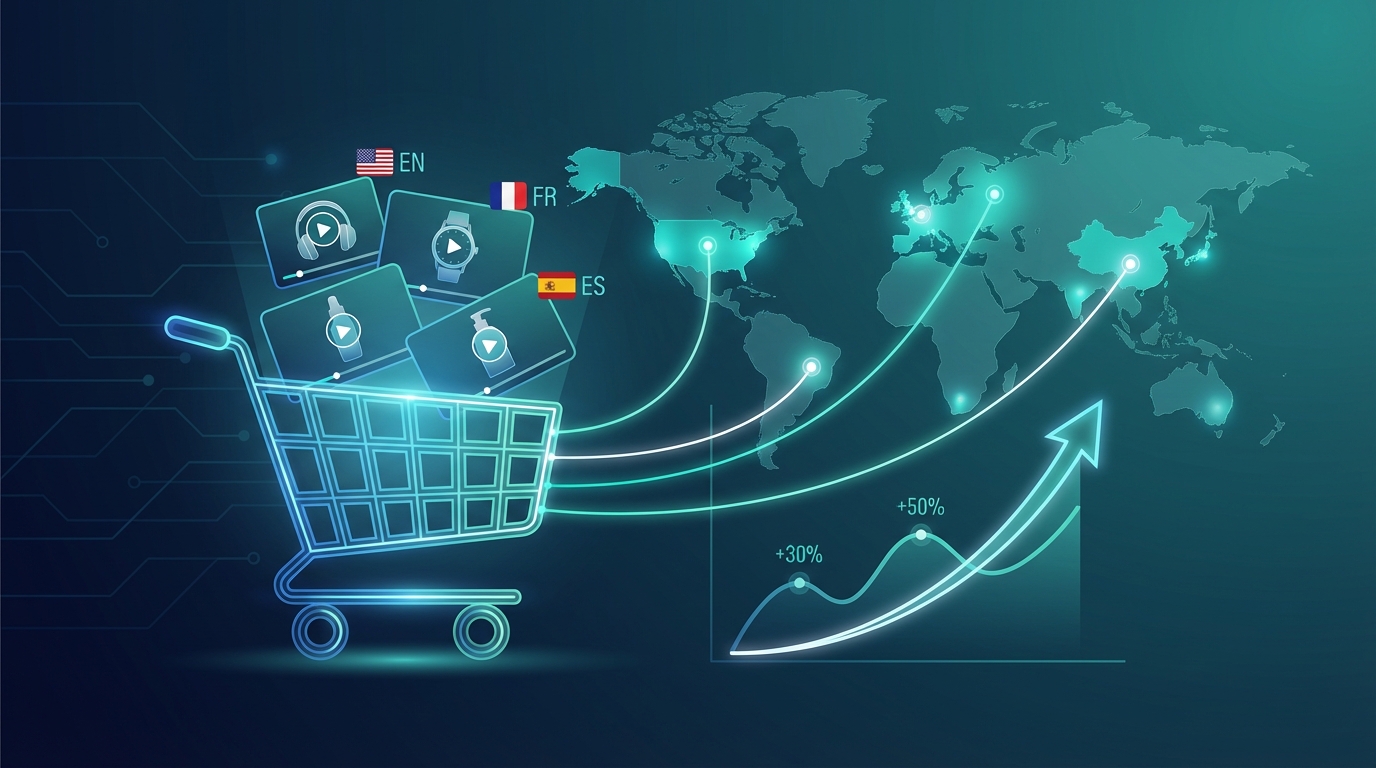
76% of online consumers prefer buying from sites in their own language. Yet most e-commerce businesses attempting international expansion simply translate product pages, completely ignoring video marketing. It's a costly mistake. Product videos increase conversions by 80% on average. But a video in a foreign language? It reduces that effectiveness by 60%. The solution is dubbing, and in 2026 AI has made it accessible even to small merchants.Important: product videos increase conversions by 80%, but only if they're in the customer's language. A non-localized video loses 60% of its effectiveness in foreign markets.💰 Why Videos Are Crucial for International E-commerce The numbers speak clearly:88% of consumers watch product videos before purchasing 73% are more likely to buy after watching a video 64% of customers buy online after seeing brand social videos Videos in local language: +40% time on page, +25% conversionsFor an e-commerce selling in multiple countries, every percentage point of conversion counts. On $100,000/month revenue, a 5% conversion increase means $5,000 more. Every month. 🎯 Which E-commerce Videos to Dub Not all videos have the same impact. Here's the priority: 1. Product Videos (Maximum ROI) Videos showing the product in action. Demonstrating use, quality, details. Why dub: The voiceover explains features that images can't convey. "This fabric is water-resistant" has more impact when said in the customer's language. Where to use: Product pages, Amazon Listings, landing pages 2. Tutorial/How-To Videos How to use the product, installation, maintenance. Why dub: They reduce returns and support requests. A customer who understands how to use the product is a satisfied customer. Where to use: Support page, post-purchase emails, YouTube 3. Brand/About Us Videos Who you are, your story, your values. Why dub: They build trust. Foreign customers are more skeptical - a story told in their language creates connection. Where to use: Homepage, "About Us" page, brand awareness campaigns 4. Testimonial Videos Customer reviews in video format. Why dub: More complex (need subtitles or dubbing of original speech), but very effective for social proof. Where to use: Landing pages, retargeting adsPro Tip: start with product videos of your 10 bestsellers. These have the highest and most immediate ROI.📊 Case Study: Italian Fashion E-commerce → Spain + Germany An Italian fashion brand with $2.2M/year revenue decided to expand into Spain and Germany. Here are the results after 6 months. Initial situation:Site translated to ES and DE Videos only in Italian Conversion rate IT: 2.8% Conversion rate ES: 1.1% Conversion rate DE: 0.9%Intervention:Dubbed 25 product videos in ES and DE Dubbed 3 brand/storytelling videos Dubbed 5 sizing/fit tutorial videos Total investment: ~$1,650 (via NovaDub)Results after 6 months:Conversion rate ES: 2.3% (+109%) Conversion rate DE: 2.1% (+133%) Revenue ES: +$200,000/year Revenue DE: +$165,000/year Dubbing ROI: 22,000%Yes, you read that right: $1,650 investment, $365,000/year return in additional revenue.Note: these results are real but represent a success case. Results vary based on product, market, and overall execution quality.💡 How to Implement a Localized Video Strategy Phase 1: Audit Existing Videos List all videos you have:Product videos Brand videos Tutorial videos Social videos Ad videosFor each, evaluate:Duration Importance (how much it impacts sales) Original audio qualityPhase 2: Prioritize by Market and Product Priority formula: Priority = (Product revenue) × (Market potential) × (Video type impact) Example:Product A generates $55K/year, Germany expansion (high potential), product video (high impact) → HIGH PRIORITY Product Z generates $2K/year, Poland expansion (medium potential), social video (medium impact) → LOW PRIORITYPhase 3: Dub in Batches Use NovaDub to dub efficiently:Upload all priority videos Select target languages (start with 2-3) Process in batch Download and organize by marketCost example - E-commerce Catalog:30 product videos × 2 minutes average × 2 languages = 120 minutes With NovaDub Pro: ~$200Phase 4: Distribute Strategically Product pages: Replace or add localized version Amazon/Marketplace: Each local listing should have video in local language Ads: Create separate campaigns per market with dubbed videos Social: Post on local channels (if you have them) or use geographic targeting Phase 5: Measure and Optimize KPIs to track:Conversion rate per country (pre/post localized videos) Time on product page Bounce rate per market Revenue per marketWarning: don't just dub. Make sure the entire customer journey is localized: site, checkout, emails, support. Videos are one piece of the puzzle.🛒 E-commerce Platforms and Multilingual Video Shopify Shopify natively supports multiple or translated stores (with apps like Langify). You can:Upload different videos for each language version Use metafields to manage localized video URLs Integrate with YouTube/Vimeo for hostingWooCommerce With WPML or Polylang:Each product can have different media per language Custom fields for localized videos Conditional shortcodes to show the right videoAmazon Seller/Vendor Central Each marketplace is separate:Amazon.com, Amazon.de, Amazon.es have separate listings Upload localized video for each marketplace A+ Content supports local language videoEtsy More limited for localization, but:You can create separate listings for different markets Video in listing can be localized Description can include links to localized YouTube videos🚀 Quick Start: Start This Week Day 1-2:Identify your 5 bestseller products Find existing videos for these productsDay 3-4:Create NovaDub account Dub videos in 2 priority languages (probably ES and DE)Day 5:Upload localized videos to product pages Set up A/B test if possibleWeek 2+:Monitor metrics Expand to other products Consider additional languages✅ Conclusion Video marketing for e-commerce works. Localized video marketing works much better. And thanks to AI, it's no longer reserved for big brands with million-dollar budgets. With an investment of a few hundred dollars you can:Dub your video catalog Increase conversions 25-100% in foreign markets Generate ROI of thousands of percentThe question isn't IF localized videos help international sales. The question is: how much are you losing every day without them?Ready to expand your e-commerce globally? Start with NovaDub - dub your product videos in minutes. Run an international e-commerce? Share your experience with localized videos in the comments!

How Much Does It Cost to Dub a Video? Complete Pricing Guide 2026
"How much will it cost to dub this video?" It's the question every creator asks before deciding whether to expand their content internationally. And the answer, until recently, was often discouraging: thousands of dollars for a single video. But 2026 has changed the game. Artificial intelligence has made dubbing accessible to everyone, with costs that are a fraction of traditional methods. Let's look at the real numbers.Important: in 2026, AI dubbing costs up to 95% less than traditional studio dubbing. A 10-minute video can be dubbed into 3 languages for under $50.💰 Traditional Dubbing: The Real Costs Let's start with the classic method. Professional studio dubbing involves:Professional translator Dialogue adapter Professional voice actor Audio technician Recording studio Post-productionAverage costs for a 10-minute video (one language):Cost Item Average PriceTranslation and adaptation $250-500Voice actor (hourly/daily rate) $400-1,000Recording studio $150-250Post-production and mixing $200-400Total $1,000-2,150Multiply by 3 languages and you're already at $3,000-6,500 for a single 10-minute video. For a creator who publishes 4 videos per week and wants to cover 3 international markets, we're talking about $48,000-104,000 per year just for dubbing. Numbers sustainable only for large productions. ⚡ AI Dubbing: The Cost Revolution The arrival of artificial intelligence dubbing has completely overturned the economics of video localization. Costs with NovaDub for a 10-minute video:Plan Price/minute Total (10 min, 1 language)Lite (with watermark) €0.99 (~$1.10) €9.90 (~$11)Pro (no watermark) €1.49 (~$1.65) €14.90 (~$16.50)To dub the same video in 3 languages:Lite plan: ~$33 Pro plan: ~$50Direct comparison: $50 vs $3,000-6,500. A savings of 98%.Pro Tip: if you produce content regularly, monthly subscriptions offer additional savings. The Creator plan (€49/month for 50 minutes) brings the effective cost down to €0.98/minute.📊 Complete Comparison TableFactor Traditional AI (NovaDub)Cost per 10 min (1 language) $1,000-2,150 $11-16.50Production time 3-7 days 10-15 minutesVoice quality Excellent Excellent (ElevenLabs)Voice consistency Variable (different actors) Perfect (voice cloning)Scalability Difficult ImmediateEdits/corrections Expensive (new session) Free (regenerate)Available languages Limited by budget 29+ languages🎯 Real Budget Examples Let's look at some concrete scenarios: Scenario 1: YouTuber with 1 video/weekAverage video: 12 minutes Target languages: Spanish, German Monthly volume: 48 minutes × 2 languages = 96 minutesTraditional cost: ~$8,000/month NovaDub Pro cost: ~$165/month (Creator plan + extra) Savings: $7,835/month = $94,020/year Scenario 2: Business with corporate videos5 onboarding videos: 30 minutes total Languages: Spanish, German, French, Japanese One-time projectTraditional cost: ~$12,000-18,000 NovaDub Pro cost: ~$200 (30 min × 4 languages × €1.49) Savings: $11,800-17,800 Scenario 3: High-volume TikTok creator20 videos/week at 1 minute each Languages: Spanish, Portuguese, German Monthly volume: 240 minutesTraditional cost: Impractical (~$48,000/month) NovaDub Business cost: €149/month (200 min included) + €59 extra Total: ~$230/monthNote: NovaDub subscription plans never have watermarks, regardless of tier. Watermark is only for Lite pay-as-you-go.💡 How to Calculate Dubbing ROI Cost is only half the equation. The other half is return on investment. Factors to consider:View increase: A video dubbed in 3 languages can easily triple potential audienceMonetization by market: CPM varies significantly:USA: $3-5 per 1000 views Germany: $3-4 Brazil: $0.50-1 India: $0.20-0.50Compound effect: Dubbed videos continue generating views for months/yearsROI calculation example:Original English video: 10,000 views, CPM $3 = $30 Spanish version: 8,000 views, CPM $1.50 = $12 German version: 5,000 views, CPM $3.50 = $17.50 Portuguese version: 6,000 views, CPM $1 = $6Total revenue: $65.50 vs $30 original = +118% Dubbing cost (3 languages, 10 min): $50 Net additional profit: $5.50 from first month, then all profit ⚠️ When Traditional Dubbing Still Makes Sense Despite AI's advantages, there are cases where traditional dubbing remains preferable: Premium films and TV series: For high-budget cinematic productions, the artistic direction of a human voice actor can make a difference. Content with strong emotional component: Dramas, touching documentaries - where every emotional nuance counts. Markets with specific expectations: Some countries (like Italy and Germany) have strong dubbing traditions and very demanding audiences. Luxury brands: Where budget isn't an issue and you want maximum creative control.Warning: don't choose traditional dubbing out of habit. Test AI first - you might be surprised by the quality and save budget for other areas.🚀 How to Start Saving If you're still paying thousands for dubbing (or giving up on localization entirely), here's how to change:Try free: NovaDub offers 5 free minutes - enough to test a short videoStart with pay-as-you-go: No monthly commitment, pay only for what you useScale gradually: Once you've verified quality, switch to subscriptions for additional savingsMonitor ROI: Use YouTube Analytics to track performance by marketReinvest savings: Budget saved can go into producing new content✅ Conclusion: Dubbing Is No Longer a Luxury In 2026, the excuse "it costs too much" no longer exists for not localizing your videos. With AI, dubbing has become accessible to any creator, from hobbyists to million-subscriber channels. The numbers speak clearly:Savings: 95-98% compared to traditional Speed: Minutes instead of days Quality: Indistinguishable from professional Scalability: InfiniteThe real question is no longer "can I afford to dub?" but "can I afford NOT to dub?". Every unlocalized video is lost audience, missed revenue, slowed growth.Calculate how much you could save. Try NovaDub free and discover the real cost for your videos. Have questions about dubbing costs? Write us at [email protected]!