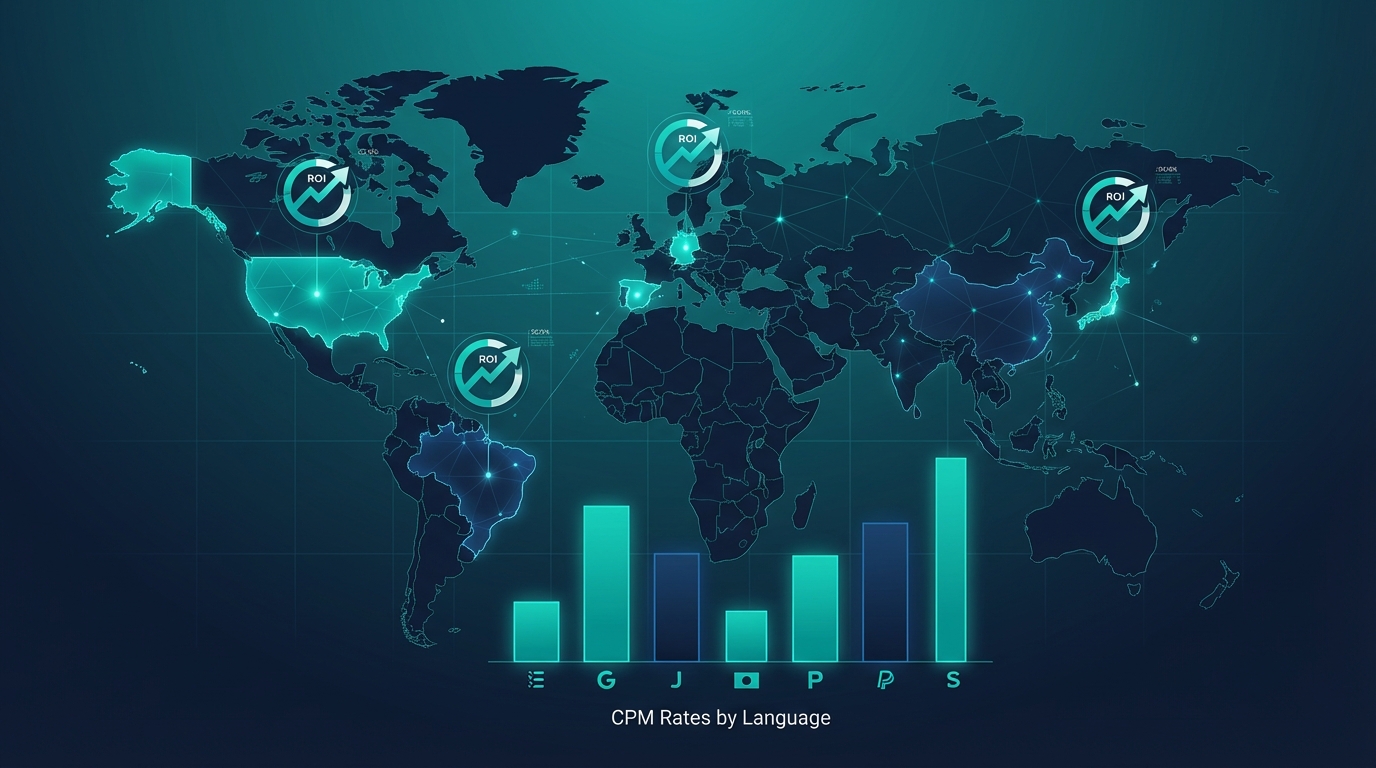

Not all languages are equal when it comes to dubbing. Some offer huge markets but low CPMs. Others have smaller audiences but excellent monetization. Some are saturated with content, others still virgin territory.
In this guide, I analyze real data to help you choose where to invest your dubbing budget to maximize return.
Info
Important: language choice depends on your content and niche. This guide provides general data - the final decision must consider your specific audience.
📊 Overall Ranking: Top 10 Languages for ROI
Based on a combination of market size, average CPM, competition, and growth, here’s the ranking:
| Rank | Language | Online Speakers | YouTube CPM | Competition | ROI Score |
|---|---|---|---|---|---|
| 1 | 🇪🇸 Spanish | 550M | $1-2.5 | Medium | ⭐⭐⭐⭐⭐ |
| 2 | 🇧🇷 Portuguese | 280M | $0.8-1.5 | Medium-Low | ⭐⭐⭐⭐⭐ |
| 3 | 🇩🇪 German | 100M | $3-4 | Medium | ⭐⭐⭐⭐ |
| 4 | 🇯🇵 Japanese | 120M | $3-5 | High | ⭐⭐⭐⭐ |
| 5 | 🇫🇷 French | 280M | $1.5-2.5 | Medium | ⭐⭐⭐⭐ |
| 6 | 🇮🇳 Hindi | 600M | $0.3-0.8 | Low | ⭐⭐⭐ |
| 7 | 🇰🇷 Korean | 80M | $2-3 | Medium-High | ⭐⭐⭐ |
| 8 | 🇮🇩 Indonesian | 200M | $0.5-1 | Low | ⭐⭐⭐ |
| 9 | 🇸🇦 Arabic | 400M | $0.8-1.5 | Medium-Low | ⭐⭐⭐ |
| 10 | 🇮🇹 Italian | 65M | $1.5-2.5 | Medium | ⭐⭐⭐ |
🇪🇸 Spanish: Massive Volume
Why dub in Spanish:
- 550 million speakers (including Latin America)
- Rapidly growing market
- Relatively less saturated than English content
- Lower advertising costs = interesting ROI
Challenges:
- Lower CPM than English
- Differences between European and Latin American Spanish
- Geographic fragmentation (20+ countries)
Ideal for: Entertainment, tutorials, lifestyle, gaming
Typical ROI: 150-300% view increase
Important note: Latin (neutral) Spanish reaches more people than European Spanish. NovaDub supports both variants.
Tip
Pro Tip: for maximum reach, use Latin American Spanish as your default. It’s understood across all Spanish-speaking countries.
Your next video could speak 29 languages
While you're reading this, thousands of people are searching for content like yours — in a language you don't publish in.
5 free minutes · No credit card needed
🇧🇷 Portuguese: The Hidden Opportunity
Why dub in Portuguese:
- Brazil = 210 million super-active social media users
- Competition still relatively low
- Very engaged audience
- Strong growth on YouTube and TikTok
Challenges:
- CPM not the highest
- Brazilian Portuguese ≠ European Portuguese
- Volatile economy
Ideal for: Gaming, music, tech, how-to, fitness
Typical ROI: 100-250% view increase
Note
Note: the Brazilian market is particularly receptive to translated content. Creators entering now build a competitive advantage that’s hard to close.
🇩🇪 German: Premium CPM
Why dub in German:
- Among the highest CPMs in the world
- High purchasing power audience
- Rooted dubbing culture (they accept synthetic voices)
- Includes Austria and German-speaking Switzerland
Challenges:
- Smaller market (100M speakers)
- Very high quality standards
- Technical and demanding audience
Ideal for: Tech, business, automotive, B2B, professional tutorials
Typical ROI: 100-200% view increase but revenue can be higher due to CPM
🇯🇵 Japanese: The Difficult but Profitable Market
Why dub in Japanese:
- Very high CPM (comparable to USA)
- Loyal audience that watches content completely
- Very developed otaku/geek culture
- Willing to pay for premium content
Challenges:
- Complex language for voice synthesis
- Specific cultural standards
- Very closed market to “outsiders”
Ideal for: Gaming, anime, tech, software tutorials, J-culture
Typical ROI: Variable - can be very high for right niches, low for others
🇫🇷 French: Solid but Competitive
Why dub in French:
- Mature and stable market
- Includes France, Belgium, Switzerland, French Canada, Francophone Africa
- Good purchasing power audience
Challenges:
- Significant competition
- Language purists (quality must be high)
- Fragmentation between regional variants
Ideal for: Lifestyle, cooking, fashion, culture, education
Typical ROI: 80-150% view increase
📈 Decision Matrix by Niche
| Niche | 1st Language | 2nd Language | 3rd Language |
|---|---|---|---|
| Tech/Software | Spanish | German | Japanese |
| Gaming | Spanish | Portuguese | French |
| Lifestyle/Vlog | Spanish | French | Portuguese |
| Business/B2B | German | Spanish | French |
| Beauty/Fashion | Spanish | Portuguese | French |
| Food/Cooking | Spanish | French | Portuguese |
| Fitness | Spanish | Portuguese | German |
| Education | Spanish | Hindi | French |
| Music/Entertainment | Spanish | Portuguese | French |
| Automotive | German | Spanish | French |
Warning
Warning: this matrix is a general guide. Always analyze your specific channel data (where current international views come from) before deciding.
💡 How to Analyze YOUR Market Potential
Before investing in dubbing, do this analysis:
Step 1: Check YouTube Analytics
Go to Analytics → Audience → Geography. Look at:
- Which countries already send views (existing interest)
- Which countries have higher watch time (engagement)
Step 2: Research Competitors
Find similar creators who already have multilingual channels:
- Which languages did they choose?
- How many subscribers do their secondary channels have?
- How do their dubbed videos perform?
Step 3: Keyword Research
Use TubeBuddy or VidIQ to search for:
- Search volume for your main keywords in each language
- Competition on those keywords
- Growth trends
Step 4: Test with Limited Budget
Before dubbing your entire catalog:
- Choose 3-5 evergreen videos
- Dub them in 2 candidate languages
- Publish and monitor for 1-2 months
- Decide based on real data
🎯 The Optimal 2026 Strategy
Based on data, here’s the recommended strategy:
Limited Budget ($50-100/month):
- Focus: Spanish
- Dub best 3-4 videos per month
- Build solid foundation before expanding
Medium Budget ($100-300/month):
- Focus: Spanish + Portuguese
- 5-8 videos per month per language
- Consider separate channel for Spanish when you reach 5K subscribers
High Budget ($300+/month):
- Focus: Spanish + Portuguese + (German or French depending on niche)
- Dub all new content
- Separate channels for main markets
- Consider additional languages for specific content
📊 ROI Calculation by Language
Simplified formula:
ROI = (Additional views × CPM / 1000) - Dubbing costPractical example:
- 10-minute video, dubbing cost: $17
- Expected views in Spanish: 5,000
- Spanish CPM: $1.50
ROI = (5,000 × $1.50 / 1000) - $17 = $7.50 - $17 = -$9.50 first month
But consider:
- Views continue for months/years
- More videos = network effect
- Some videos explode
In practice, long-term ROI is almost always positive for main languages.
✅ Conclusion
Language choice for dubbing shouldn’t be random. With the right data, you can build a strategy that maximizes your ROI.
Golden rules:
- Spanish for volume - massive market, manageable competition
- Portuguese for opportunity - growing market, window still open
- German for revenue - premium CPM, premium audience
- Test before scaling - data > intuition
- Consistency beats everything - 2 solid languages better than 5 abandoned ones
With NovaDub you can test any language with minimal investment. Start with your best videos, measure results, then scale what works.
Ready to conquer new markets? Try NovaDub free and start testing the languages best suited to your content.
Which language worked best for your channel? Share your experience in the comments!
Creators worldwide use NovaDub
"NovaDub revolutionized my channel. Now I reach audiences in 5 different languages with the same voice quality."
"The AI dubbing quality is incredible. My international followers can't believe it's automated!"
"We reduced localization costs by 80% while maintaining professional quality."
"Our courses now reach students worldwide. The audio quality is so natural it sounds like human dubbing."